Start with what already exists.
No product yet? Decide what V1 needs to prove.
Product already exists? Decide what deserves fixing.
Workflow already exists? Decide what deserves automation.
Offers decide what should happen next. Services are how we implement it.
You have the idea.You don't know what V1 needs yet.
Before turning assumptions into development cost, this decides exactly what your first version needs to prove — not the whole product, the one thing.
What You Get
Build-Ready V1 Brief
A documented decision — what belongs in V1, what doesn't, and why — yours to build with us or hand to any other team.
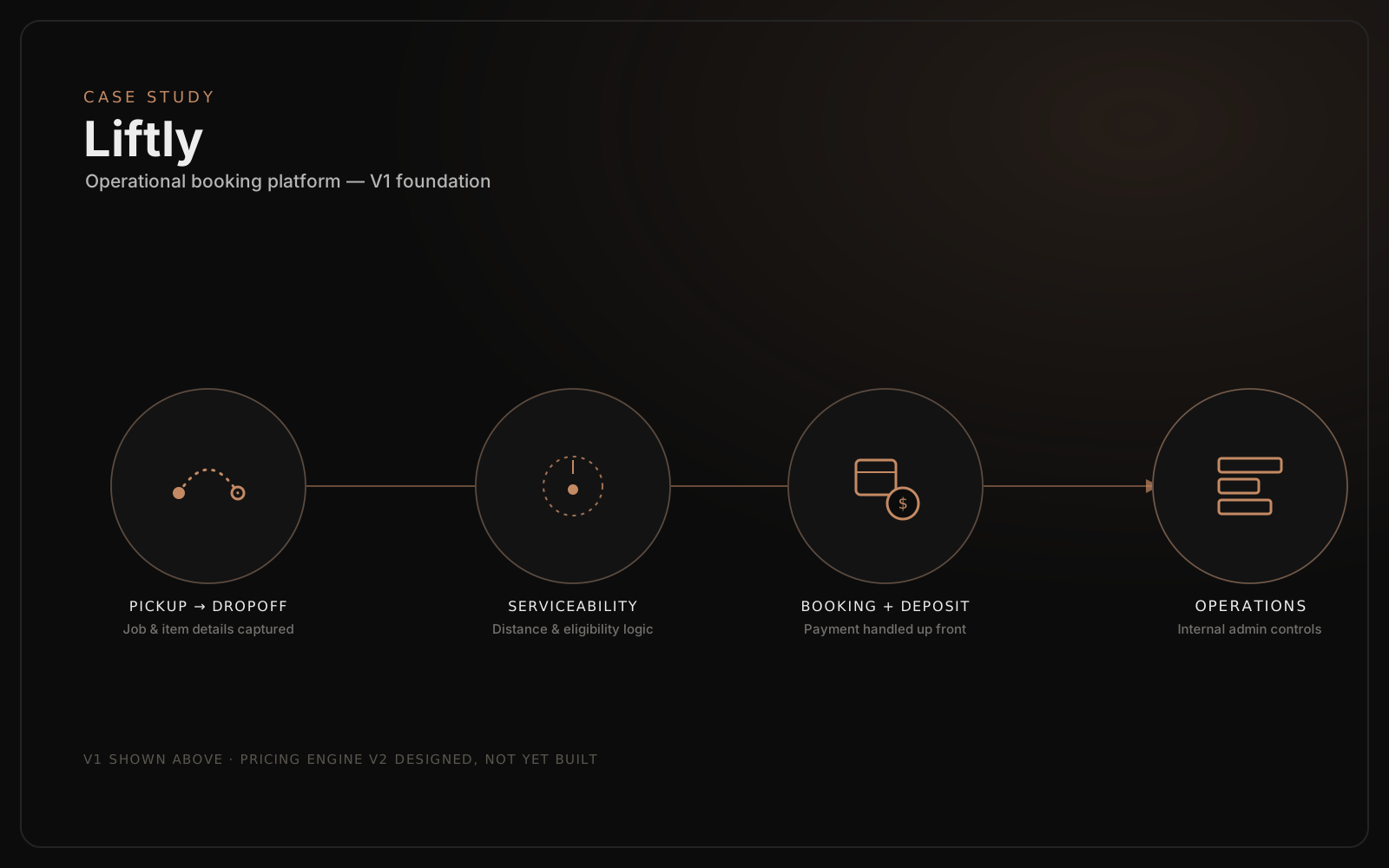
Liftly
The founder's broader marketplace vision already existed — a logistics platform with a sophisticated variable-pricing engine as the real differentiator. We separated the vision from the first release: V1 shipped the operational core — booking, serviceability, payment, admin — as a complete system on its own. The pricing engine was scoped and documented for a defined V2, not built prematurely into a release that didn't need it yet.
See the case studyWhy Now
Right now
A wrong guess costs a conversation.
The V1 boundary is still just a decision — changing your mind here costs nothing but time.
Mid-build
A wrong guess costs sprints.
Code exists for the wrong version. Undoing it means rewriting, not reprioritizing.
After launch
A wrong guess costs trust.
Early users formed an opinion of the wrong product. That's harder to walk back than code.
This is for you if
- An idea exists, but V1's boundary doesn't yet
- You want the decision made before development spend, not during it
- You're fine building the result with us or another team
Not for you if
- Something's already built and the problem is what's wrong with it — that's Product Rescue
- You already have a validated, specific V1 scope — you need a build, not a decision
The code exists.You don't know what's wrong.
Before another sprint or rebuild, this finds out — from evidence, not a guess — what actually deserves fixing, replacing, or keeping.
What You Get
Rescue Brief
An evidence-based read on what to keep, what to fix, and where a rebuild is actually justified — not a guess.
Fast Track USA
Josh Nyce, owner and founder, describes roughly two years with a previous team without a reliable launch. Zumetrix took the project over and shipped it in three weeks — bug-free, by his account, on video and in a separately-worded, verified Trustpilot review corroborated on Google.
See the full case studyWhy Now
Right now
A wrong diagnosis costs a conversation.
Nothing has been built on the guess yet — changing course here costs nothing but time.
Next fix
A wrong diagnosis costs a sprint.
Work goes into patching a symptom. If it was the wrong one, that work doesn't transfer.
Next rebuild
A wrong diagnosis costs a rebuild.
The biggest bet, made on the same unverified read of what's actually wrong.
This is for you if
- A real product already exists — stalled, breaking, inherited, or just not trusted anymore
- You can share access or evidence if accepted (we never ask for credentials up front)
- You want an outside, evidence-based read before spending on another attempt
Not for you if
- Nothing's been built yet — that's a V1 decision, not a rescue. Try Idea-to-Build instead
- You already know exactly what's wrong and just need it fixed — that's implementation, a service, not this assessment
The workflow works.You don't know what's worth automating.
Before adding another tool, this decides what should actually be automated, simplified, connected, or left for a person to keep doing.
What You Get
Workflow System Plan
A clear plan for what to remove, simplify, connect, automate, or keep human — a decision, not a tool recommendation.
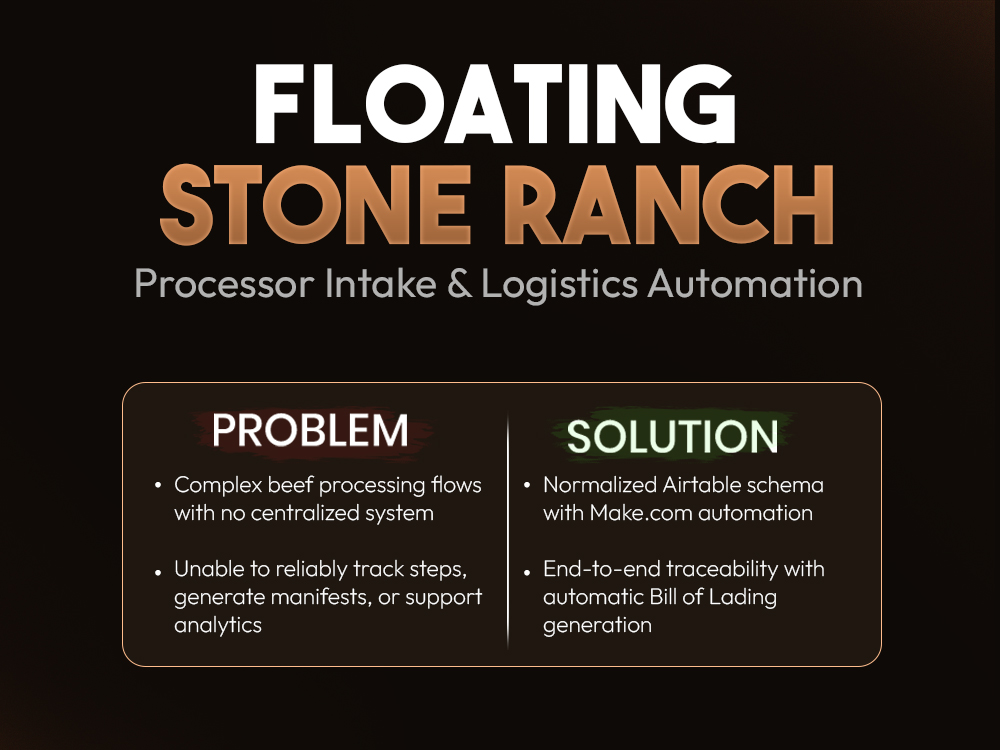
Floating Stone Ranch
A beef processor's carcass intake, boxing, and shipping ran on spreadsheets and paper — no single source of truth, no reliable manifest. We centralized it into one Airtable-backed system and automated the status transitions that used to be tracked by hand, with a structure built to support the reporting that comes next.
See the case studyWhy Now
This week
One person quietly absorbs it.
It feels manageable — a few extra minutes per handoff, easy to not notice.
This quarter
It becomes "how we do things."
New hires learn the workaround as normal, not as a problem worth fixing.
Next hire
You hire to cover the workflow.
Not because the business grew — because a person is now load-bearing infrastructure.
This is for you if
- A real, recurring workflow already runs today — carried by people, not a system
- You want to know what's actually worth automating before buying another tool
- You're open to some of it staying human — that's a legitimate outcome, not a failure
Not for you if
- Nothing's running manually yet to analyze — there's no workflow to automate
- You already know exactly what to automate and just need it built — that's implementation, a service, not this sprint
Most engagements start with a conversation. This one starts with a decision.
The Usual Way
Open-ended discovery call, then a scope that firms up (or doesn't) once work has already started.
Zumetrix
A bounded, fixed-price assessment. You know the cost and the timeline before anything begins.
The Usual Way
The exploration happens on your dime, inside the build — figuring out what's actually needed while you're already paying to build it.
Zumetrix
The decision happens first, on its own. What gets built is informed by it, not tangled with it.
The Usual Way
If it doesn't work out, you've paid for partial work and still don't have clarity.
Zumetrix
You keep the Brief either way — usable with us or with anyone else. Nothing about it depends on hiring us next.
Different decision. Same engagement model.
None of These Sound Exactly Right?
Don't choose an offer just to choose one.
Tell us what's happening. We'll tell you honestly whether one of these fits — or whether you shouldn't buy one at all.